
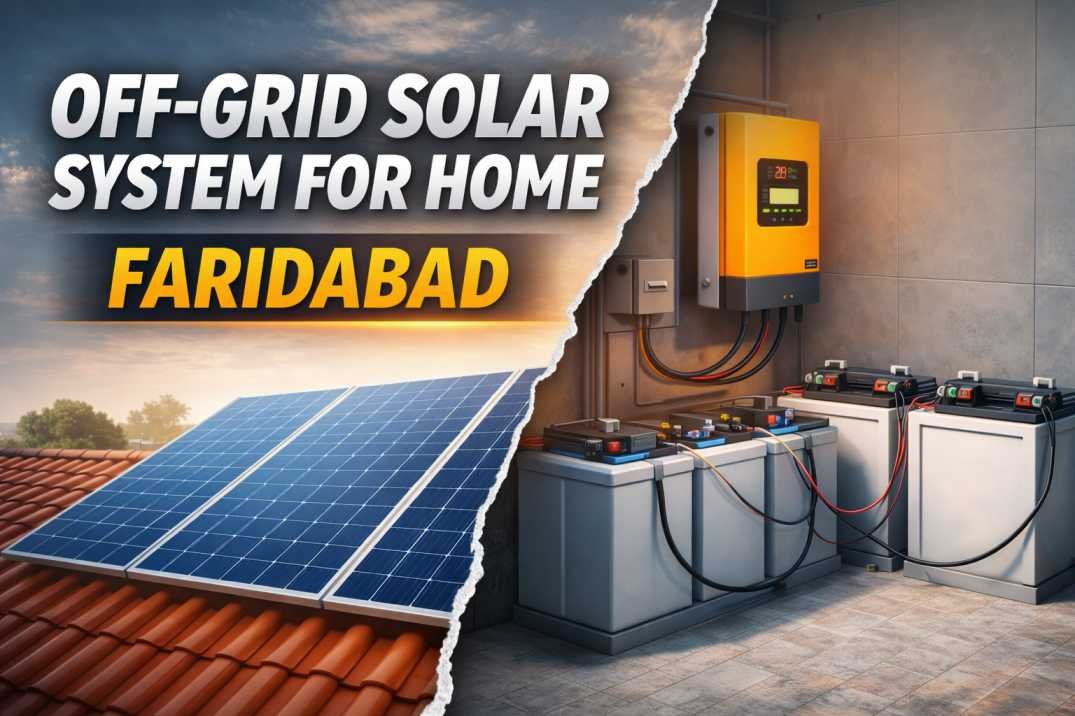
With rising electricity costs, frequent power cuts in some residential areas, and growing awareness of clean energy, many homeowners are now exploring off grid solar systems for home in Faridabad. Unlike conventional grid-dependent electricity, off-grid solar offers complete energy independence, making it an attractive option for houses that want reliable and sustainable power.
This practical guide explains everything homeowners need to know about off-grid solar systems in Faridabad—how they work, components involved, system sizing, costs, benefits, limitations, and whether this solution is right for your home.
What Is an Off-Grid Solar System?
An off-grid solar system is a standalone power system that operates independently of the government electricity grid. It generates electricity using solar panels, stores energy in batteries, and supplies power through an inverter whenever required.
Unlike on-grid systems, off-grid solar systems:
- Do not rely on grid power
- Do not export excess electricity
- Continue working even during power outages
For homeowners in Faridabad, off-grid systems are especially useful in areas facing voltage fluctuations, load shedding, or limited grid access.
Why Choose an Off-Grid Solar System for Home in Faridabad?
Frequent Power Outages
Certain residential zones, farmhouses, and outskirts still experience power interruptions. Off-grid solar ensures uninterrupted electricity regardless of grid availability.
Complete Energy Independence
With an off-grid solar system, homeowners are no longer dependent on electricity boards, tariff hikes, or supply failures.
Ideal for Independent Houses and Farmhouses
Villas, independent houses, and farmhouses in and around Faridabad benefit most, especially where grid extension is expensive or unreliable.
Environment-Friendly Living
Solar energy reduces carbon emissions and promotes sustainable living, aligning with long-term environmental goals.
How an Off-Grid Solar System Works
- Solar Panels capture sunlight and generate DC electricity.
- Charge Controller regulates voltage and current going to batteries.
- Battery Bank stores electricity for night-time or cloudy conditions.
- Solar Inverter converts DC power into AC power for household appliances.
- Distribution Panel supplies power safely throughout the home.
The system is designed to meet your daily energy needs without depending on the grid.
Key Components of an Off-Grid Solar System
Solar Panels
High-efficiency mono or polycrystalline panels are used depending on roof space and energy requirements. Roof orientation and shadow-free placement are critical for performance.
Solar Inverter
Off-grid inverters manage power flow between panels, batteries, and household loads. Hybrid inverters may also be used for future grid integration.
Battery Storage
Batteries are the backbone of off-grid systems. Options include:
- Tubular lead-acid batteries
- Gel or AGM batteries
- Lithium-ion batteries (higher cost, longer life)
Charge Controller
MPPT charge controllers are preferred as they improve charging efficiency and overall system performance.
Sizing an Off-Grid Solar System for Home
Proper system sizing is essential for reliability and cost control.
Step 1: Calculate Daily Power Consumption
List appliances such as lights, fans, refrigerator, TV, air cooler, water pump, and calculate total daily units (kWh).
Example:
- Lights & fans: 2 kWh/day
- Refrigerator: 1 kWh/day
- TV & electronics: 0.5 kWh/day
- Water pump: 1 kWh/day
Total: ~4.5 kWh/day
Step 2: Decide Battery Backup Requirement
Most homes opt for 1 to 2 days of backup depending on reliability needs.
Step 3: Select Panel Capacity
Based on Faridabad’s average sunlight (5–6 peak sun hours), a 5 kW system can generate around 20–25 units per day under ideal conditions.
Typical Off-Grid Solar System Sizes for Homes
- 1 kW: Basic lighting, fans, small appliances
- 3 kW: Medium homes with refrigerator and pump
- 5 kW: Large homes with multiple appliances
- 10 kW: Villas, farmhouses, high consumption households
The final size depends on load profile, roof area, and budget.
Cost of Off-Grid Solar System for Home in Faridabad
The cost depends on system size, battery type, and component quality.
Approximate price range:
- 1 kW: ₹1.5–2.0 lakh
- 3 kW: ₹3.5–5.0 lakh
- 5 kW: ₹6.0–8.5 lakh
Lithium battery systems cost more initially but offer longer life and better performance.
Advantages of Off-Grid Solar System
Power Backup Without Diesel
Eliminates dependency on diesel generators and rising fuel costs.
Long-Term Cost Savings
After initial investment, electricity is virtually free except for battery replacement after several years.
Reliable Power Supply
Ideal for medical equipment, home offices, and essential appliances.
Scalable System Design
Systems can be expanded later with additional panels or batteries.
Limitations You Should Consider
Higher Initial Cost
Battery storage significantly increases upfront investment compared to on-grid systems.
Battery Maintenance
Lead-acid batteries require periodic maintenance and replacement.
Space Requirement
Off-grid systems need additional space for battery banks and inverter setup.
Careful Load Management
Heavy loads like air conditioners require larger system capacity and higher costs.
Off-Grid vs On-Grid Solar for Homes
| Feature | Off-Grid Solar | On-Grid Solar |
|---|---|---|
| Grid Dependency | No | Yes |
| Power During Outage | Yes | No |
| Battery Required | Yes | No |
| Net Metering | Not Required | Required |
| Initial Cost | Higher | Lower |
Homes prioritizing power reliability prefer off-grid systems, while grid-connected homes aiming for bill savings choose on-grid systems.
Is Off-Grid Solar Right for Your Home in Faridabad?
Off-grid solar systems are ideal if:
- You face frequent power cuts
- You own an independent house or farmhouse
- You need guaranteed backup power
- You want complete energy independence
For apartments or homes with reliable grid power, hybrid systems may be a better balance.
Installation Process for Off-Grid Solar System
- Site survey and load assessment
- System design and capacity finalization
- Structure fabrication and panel installation
- Inverter, battery, and wiring installation
- Testing, commissioning, and user training
Professional installation ensures safety, efficiency, and long-term performance.
Maintenance and Lifespan
- Solar panels last 25+ years
- Inverters last 8–12 years
- Batteries last 3–5 years (lead-acid) or 10+ years (lithium)
Regular cleaning and basic inspections are enough to maintain performance.
Conclusion
An off grid solar system for home in Faridabad is a practical and future-ready solution for homeowners seeking uninterrupted power and energy independence. While the initial investment is higher than grid-tied systems, the long-term reliability, savings, and sustainability make it a worthwhile choice—especially for independent houses and areas with power reliability issues.
By carefully assessing your energy needs, choosing quality components, and working with an experienced solar EPC provider, you can enjoy clean, reliable electricity for decades while reducing your environmental footprint.