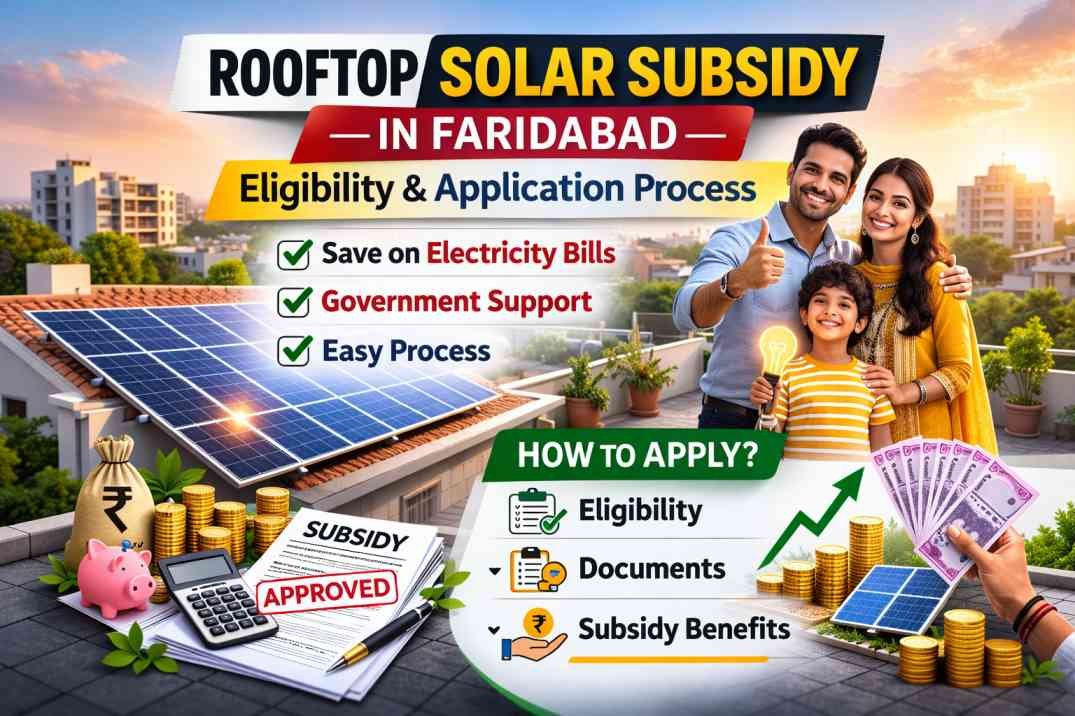
India has launched an ambitious agenda to accelerate clean energy adoption across the country. Rooftop solar systems play a central role in this strategy. For residents and businesses in Faridabad, adopting rooftop solar can mean lower electricity bills, greater energy independence, and a valuable contribution to environmental sustainability. However, rooftop solar systems can require significant upfront investment. This is where government-backed subsidies make a strong financial difference.
Under central and state schemes, eligible homeowners and establishments in Haryana — including Faridabad — can receive significant support to reduce the cost of solar panel installation. This article covers everything you need to know about rooftop solar subsidy in Faridabad, including eligibility criteria, the application process, subsidy benefits, and key steps to secure the subsidy.
What Is the Rooftop Solar Subsidy?
The rooftop solar subsidy is a financial incentive provided by the Government of India through the PM Surya Ghar: Muft Bijli Yojana and related rooftop solar schemes, supported by the Ministry of New and Renewable Energy (MNRE). The objective is to make solar energy more affordable and increase residential rooftop solar installations across the country.
Under this national scheme, residential rooftop solar systems receive direct subsidy amounts based on system capacity (in kW). The subsidy is credited electronically to your bank account post installation and commissioning.
In addition to the central subsidy, some states — including Haryana — provide additional financial assistance to further reduce the financial burden for eligible beneficiaries under their own state solar programs.
Why Rooftop Solar Subsidy Matters for Faridabad Residents
Faridabad, part of the National Capital Region (NCR) and located in Haryana, experiences high electricity demand due to hot summers. Rooftop solar enables homeowners and businesses to reduce grid dependency, cut electricity costs, and even earn credits by exporting excess energy back to the grid through net metering.
Subsidized solar systems make this transition more accessible, particularly for mid-income and middle-class households. In areas like Faridabad where electricity tariffs can be high and demand peaks are steep, solar subsidies significantly shorten the payback period for solar investments and make clean energy an attainable goal for more residents.
Subsidy Structure: Central & State Components
Central Subsidy (PM Surya Ghar / MNRE)
The central subsidy under the PM Surya Ghar scheme offers financial assistance based on system capacity. Typical figures under the current scheme include:
- 1 kW system: subsidy around ₹30,000
- 2 kW system: subsidy around ₹60,000
- 3 kW or more: maximum subsidy capped at ₹78,000
These amounts are general guidelines and represent typical central subsidy support.
The subsidy applies to grid-connected systems and is designed to encourage residential homeowners to adopt solar power by reducing upfront system costs significantly.
Additional State Subsidy (Haryana)
Haryana sometimes offers supplementary financial assistance for rooftop solar installations — especially for specific income categories — in addition to the central subsidy. According to state guidelines, additional financial support can be available for households with certain income levels on a first-come, first-served basis:
- Category I (annual family income up to ₹1.8 lakh): up to ~₹25,000 per kW or 40% of billed amount (whichever is lower)
- Category II (annual family income between ₹1.8 lakh and ₹3 lakh): up to ~₹10,000 per kW or 20% of billed amount (whichever is lower)
This additional assistance typically applies to systems up to 2 kW under the Haryana state financial assistance program, complementing the central subsidy.
Together, these central and state subsidies make rooftop solar far more affordable for eligible homeowners in Faridabad.
Eligibility Criteria for Rooftop Solar Subsidy in Faridabad
To qualify for federal and state subsidy support, applicants must meet specific eligibility requirements. These generally include:
1. Indian Citizenship
The applicant should be an Indian citizen. Residency in Faridabad or within the Haryana DISCOM (electricity distribution company) area strengthens the eligibility context.
2. Rooftop Ownership and Electricity Connection
- You must own the rooftop or have legal rights to install a solar system there.
- A valid electricity connection in your name is usually required.
3. Annual Family Income (for State Subsidy)
To avail state financial assistance, you may need to provide income proof aligning with Haryana’s defined income categories.
4. Compliance with Scheme Terms
- The system should be grid-connected and follow technical standards prescribed by MNRE.
- The solar panels and inverters should meet BIS, IEC, or other quality standards set by the ministry.
5. No Prior Subsidy Availment
Applicants should not have previously availed another solar subsidy for the same system.
Meeting these conditions makes you eligible for central subsidy benefits and, where relevant, additional state support.
Document Checklist Before Applying
Having your documents ready smoothens the application process. Typical documents include:
- Aadhaar card or other identity proof
- PAN card
- Recent electricity bill in your name
- Proof of rooftop ownership
- Bank account details (for direct benefit transfer)
- Income certificate (if seeking state subsidy)
- Parivar Pehchan Patra (PPP) or similar family ID where required
Keep these documents scanned and organized before beginning the online application process.
Step-by-Step Application Process
The rooftop solar subsidy application process is largely online and straightforward:
Step 1: Register on the Official Solar Rooftop Portal
Visit the official PM Surya Ghar/National Rooftop Solar Portal and select your state (Haryana) and electricity DISCOM details.
Step 2: Provide Consumer Details
Enter your electricity connection number, mobile number, and email to create your login profile.
Step 3: Complete the Application Form
Fill in the required details regarding your premises, rooftop space, and required solar system capacity. Choose from a list of empanelled vendors for installation.
Step 4: Feasibility & Approval
Once your application is submitted, the DISCOM authority reviews it for technical feasibility. After approval, you receive confirmation and can proceed with installation.
Step 5: Installation
Get your solar system installed through a registered and empanelled vendor. Post installation, net metering and on-site inspection are arranged.
Step 6: Submit Post-Installation Details
Upload commissioning evidence, net meter details, and other required documents on the portal.
Step 7: Commissioning Certificate & Subsidy Disbursement
After inspection and certification, the subsidy amount is directly credited to your bank account.
This digital flow ensures transparency — from application to crediting the subsidy.
Net Metering and Ongoing Benefits
Once your solar system is installed and connected to the grid with a net meter, you benefit from:
- Reduced electricity bills: Solar generation offsets grid consumption.
- Energy credits: Surplus energy exported to the grid earns credits.
- Long-term savings: Rooftop solar systems typically last 20+ years with minimal maintenance.
Net metering amplifies the financial appeal of rooftop solar systems, further enhancing the benefits of government subsidies.
Common Challenges and Tips to Avoid Delays
While the process has been streamlined, applicants sometimes face delays due to incomplete documentation, incorrect portal entries, or lack of certified vendors. To avoid this:
- Ensure all details are accurate and documents are clearly scanned.
- Choose an empanelled installer approved by your DISCOM.
- Follow up on feasibility status and inspection timelines.
- Keep copies of all acknowledgement numbers and certificates.
Preparing in advance and following the official steps reduces friction in securing the subsidy.
Final Thoughts
The rooftop solar subsidy in Faridabad — backed by national and state schemes — makes solar energy adoption financially appealing for homeowners and businesses alike. Subsidies directly reduce installation costs, while net metering ensures ongoing savings on electricity bills.
If you own a rooftop in Faridabad and are considering solar, understanding eligibility and following the structured application process is key. With proper planning and documentation, you could benefit from significant government support as you transition to clean, renewable energy.