
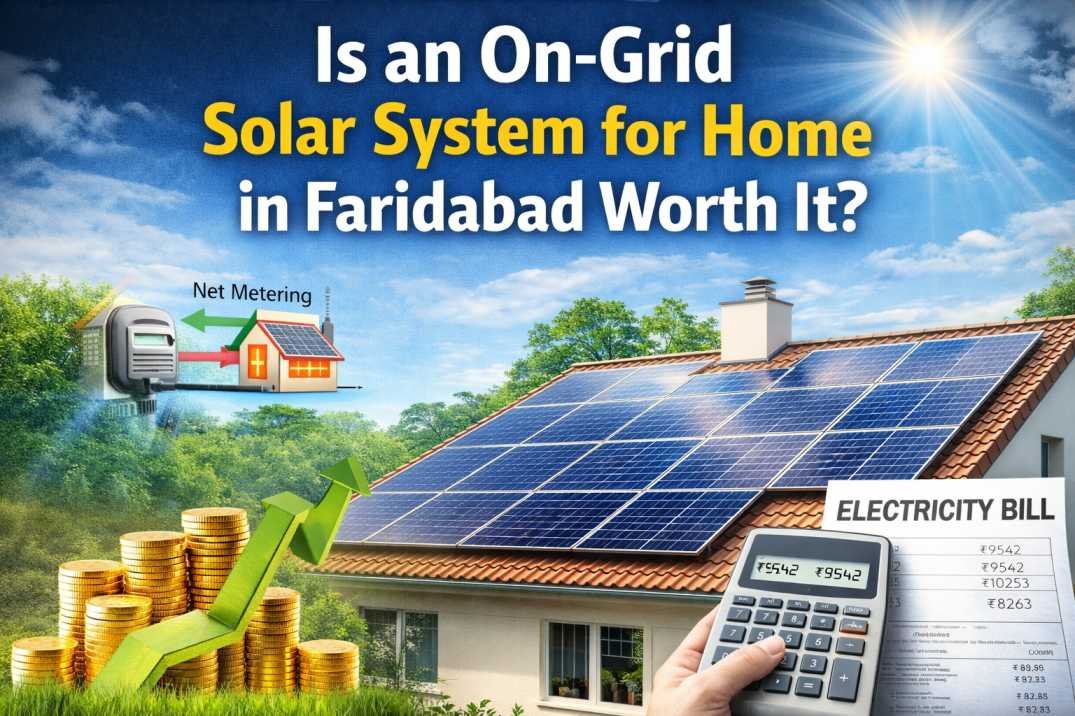
With electricity tariffs steadily rising and awareness of renewable energy growing, homeowners in Faridabad are increasingly considering solar power as a long-term solution. Among the different solar options available, the on grid solar system for home in Faridabad is the most popular choice for residential users. But before investing, it is important to understand whether it is truly worth the cost, how it works, what benefits it offers, and whether it suits your specific household needs.
This detailed guide answers all those questions and helps you make an informed decision.
Understanding the On-Grid Solar System
An on-grid solar system, also known as a grid-tied solar system, is connected directly to the electricity grid. Solar panels installed on your rooftop generate electricity during daylight hours. This power is first used to meet your home’s electrical demand. Any surplus electricity is exported to the grid through a net meter, while any shortfall is automatically supplied by the grid.
Unlike off-grid systems, on-grid solar systems do not require batteries. This significantly reduces installation costs and maintenance requirements, making them ideal for urban and semi-urban homes with reliable grid connectivity—such as Faridabad.
Why Faridabad Is Ideal for Residential On-Grid Solar
Faridabad has several advantages that make solar adoption highly practical for homeowners.
First, the city receives strong solar irradiation for most of the year, allowing solar panels to generate power efficiently. Second, residential areas generally have stable grid electricity, which is essential for on-grid systems to function effectively. Third, Haryana supports residential solar adoption through net metering and central government subsidy schemes.
These factors combined make an on grid solar system for home in Faridabad a financially and technically sound investment.
How an On-Grid Solar System Works in a Home
The working of an on-grid solar system is simple yet highly efficient.
Solar panels mounted on the rooftop capture sunlight and convert it into direct current (DC) electricity. A solar inverter then converts this DC power into alternating current (AC), which is used by household appliances such as lights, fans, refrigerators, air conditioners, and washing machines.
If your system generates more electricity than your home consumes, the excess power is sent to the electricity grid through a bi-directional net meter. When solar generation is low—such as at night or during cloudy weather—the required power is drawn from the grid automatically.
This seamless exchange ensures uninterrupted electricity without the need for batteries.
Cost of an On-Grid Solar System for Home in Faridabad
The cost of installing an on grid solar system for home in Faridabad depends on multiple factors, including system capacity, quality of components, inverter type, mounting structure, and installation complexity.
On average:
- A 1 kW system is suitable for small households with limited electricity usage
- A 3 kW system works well for standard families using common appliances
- A 5 kW system is ideal for larger homes with air conditioners and higher loads
- Villas or large independent houses may require 7 kW to 10 kW systems
Although the upfront investment may seem significant, government subsidies and long-term electricity savings greatly reduce the effective cost. Most homeowners recover their investment within 4 to 6 years, after which the electricity generated is almost free.
Government Subsidy Benefits for Residential Solar
One of the biggest reasons why an on grid solar system for home in Faridabad is worth considering is the availability of government subsidies.
Residential rooftop solar systems are eligible for central government subsidies when installed through approved vendors. The subsidy amount depends on system size and applicable government policies at the time of installation.
This financial support significantly lowers the initial investment and improves the return on investment for homeowners. It also makes solar energy accessible to middle-income households.
Net Metering Explained
Net metering is a critical component of on-grid solar systems. It allows homeowners to export surplus electricity to the grid and receive credits against their electricity consumption.
In Faridabad, net metering enables:
- Reduction in monthly electricity bills
- Efficient utilization of surplus solar power
- Faster payback on solar investment
At the end of each billing cycle, you are charged only for the net electricity consumed after adjusting exported units. In many cases, homeowners experience electricity bills reduced to minimal fixed charges.
Electricity Bill Savings and Long-Term Returns
The primary motivation for installing an on grid solar system for home in Faridabad is long-term cost savings.
Solar systems typically operate efficiently for 25 years or more. With rising electricity tariffs, the savings increase year after year. Over the system’s lifetime, homeowners can save several times the initial investment in electricity costs.
In addition to financial savings, solar power offers predictability. You are less affected by tariff hikes, peak-hour charges, and policy changes in electricity pricing.
Maintenance Requirements for On-Grid Solar Systems
One of the major advantages of on-grid solar systems is low maintenance.
Solar panels require periodic cleaning to remove dust and dirt, especially in urban and industrial regions like Faridabad. Apart from cleaning and routine inspections, there are no major maintenance expenses.
Most panels come with performance warranties of 25 years, while inverters typically have warranties ranging from 5 to 10 years, depending on the brand.
Limitations of On-Grid Solar Systems
While an on grid solar system for home in Faridabad offers numerous benefits, it is important to understand its limitations.
The biggest drawback is the lack of power backup during grid outages. For safety reasons, on-grid systems shut down when the grid fails to prevent electricity from feeding back into the grid during maintenance or repairs.
Additionally, system performance depends on sunlight availability, and net metering approval timelines can vary based on local regulations.
Homeowners who face frequent power cuts may consider hybrid systems with battery backup.
On-Grid vs Off-Grid vs Hybrid Solar Systems
Understanding the difference between solar system types helps homeowners make the right choice.
On-grid systems are cost-effective, subsidy-eligible, and ideal for homes with stable grid supply. Off-grid systems include batteries and provide complete independence from the grid but involve higher costs and maintenance. Hybrid systems combine grid connectivity with battery backup, offering flexibility but at a higher investment.
For most residential users in Faridabad, on-grid solar remains the most practical and economical option.
Rooftop Space and Structural Considerations
Before installing an on grid solar system for home in Faridabad, it is essential to assess rooftop space and structural strength.
A typical 1 kW solar system requires approximately 80 to 100 square feet of shadow-free area. Roof orientation, tilt angle, and shading from nearby buildings also affect system performance.
A professional site survey helps determine feasibility, optimal system size, and expected energy generation.
Environmental Impact and Sustainability
Apart from financial benefits, solar power significantly reduces carbon footprint. By switching to an on-grid solar system, homeowners contribute to cleaner air, lower greenhouse gas emissions, and reduced dependence on fossil fuels.
Over its lifetime, a residential solar system can offset several tons of carbon dioxide emissions, supporting India’s renewable energy goals and environmental commitments.
Is an On-Grid Solar System Worth It for Homes in Faridabad?
For homeowners with sufficient rooftop space and reliable grid electricity, an on grid solar system for home in Faridabad is absolutely worth it. The combination of government subsidies, net metering benefits, rising electricity costs, and long system life makes it a smart financial and environmental investment.
It offers energy savings, predictable electricity expenses, minimal maintenance, and long-term value addition to your property.
Final Thoughts
Installing an on grid solar system for home in Faridabad is not just a cost-saving decision—it is a forward-looking investment in energy security and sustainability. With the right system design, quality components, and professional installation, homeowners can enjoy reliable solar power for decades.
Before proceeding, it is advisable to conduct a detailed site assessment and consult an experienced solar EPC provider to ensure optimal system sizing, compliance, and maximum return on investment.