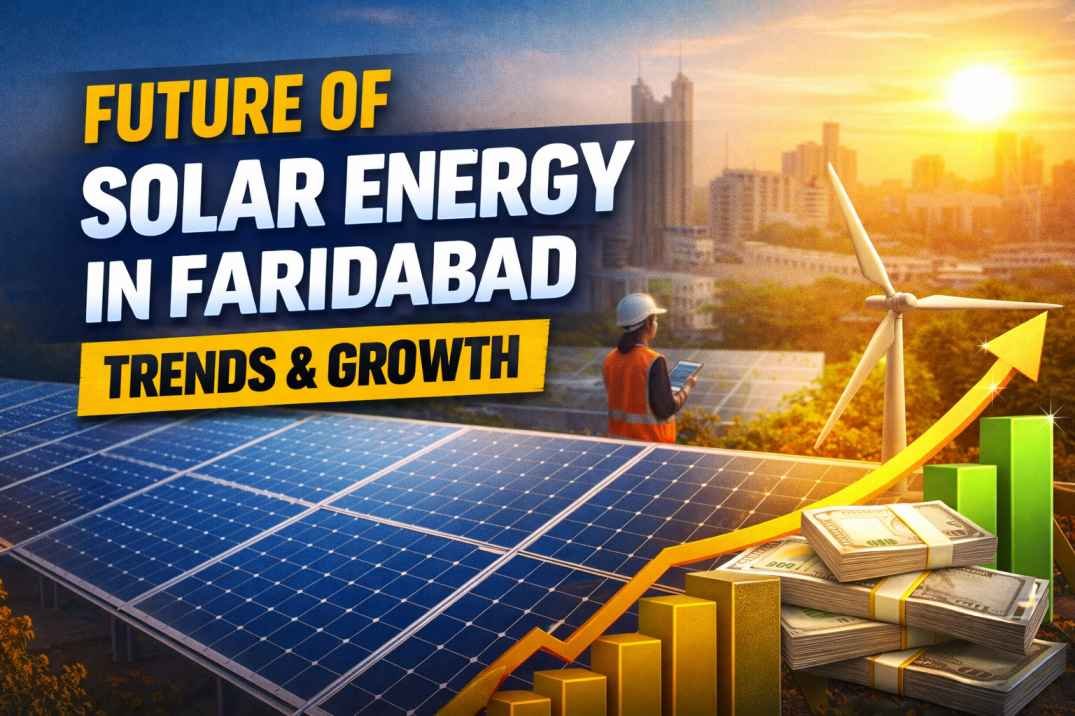
The future of solar energy in Faridabad looks exceptionally promising as India rapidly transitions toward clean and renewable energy. With rising electricity costs, increasing environmental awareness, and strong government support, solar energy is no longer just an alternative—it is becoming a mainstream power solution.
Faridabad, being a key industrial hub in Haryana and part of the Delhi NCR region, is witnessing significant growth in solar adoption across residential, commercial, and industrial sectors. This article explores the latest trends, growth drivers, challenges, and future outlook of solar energy in the city.
Introduction to Solar Energy Growth in India
To understand the solar energy future in Faridabad, it is important to look at the national picture.
India has emerged as one of the fastest-growing solar markets in the world. As of 2025, the country has crossed 132 GW of installed solar capacity, with solar being the largest contributor to renewable energy growth.
The government aims to achieve 500 GW of non-fossil fuel capacity by 2030, with solar energy playing a dominant role.
This national momentum directly impacts cities like Faridabad, where urban infrastructure and industrial demand create ideal conditions for solar expansion.
Why Faridabad is Emerging as a Solar Hotspot
Faridabad has several advantages that make it ideal for solar energy adoption:
1. Industrial Demand
Faridabad is home to thousands of manufacturing units and industries. These businesses require high energy consumption, making solar a cost-effective solution.
2. Rooftop Availability
Commercial buildings, factories, and residential complexes offer large rooftop spaces, perfect for solar installations.
3. Proximity to Delhi NCR
Being part of NCR ensures better access to solar infrastructure, vendors, and government schemes.
4. Rising Electricity Costs
Increasing power tariffs are pushing businesses and homeowners to shift toward solar energy for long-term savings.
Key Trends Shaping the Solar Energy Future in Faridabad
1. Rapid Growth of Rooftop Solar
One of the biggest trends is the rise of rooftop solar systems.
In 2025 alone, India added 7.1 GW of rooftop solar capacity, marking a 123% year-on-year growth.
Residential consumers contributed nearly 76% of installations, showing strong household adoption.
This trend is clearly visible in Faridabad, where:
- Homeowners are installing rooftop systems to reduce electricity bills
- Businesses are adopting solar for operational cost savings
- Housing societies are moving toward shared solar systems
2. Government Schemes Driving Adoption
Government initiatives are playing a crucial role in accelerating solar adoption.
Key schemes include:
- PM Surya Ghar Yojana (for residential rooftop solar)
- Net metering policies
- State subsidies and incentives
These programs reduce upfront costs and make solar more accessible.
As subsidies become more streamlined and approvals digitized, adoption in cities like Faridabad is expected to rise even faster.
3. Technological Advancements in Solar Panels
Solar technology is evolving rapidly, improving efficiency and performance.
Modern innovations include:
- High-efficiency MonoPERC panels
- Bifacial solar modules generating up to 25% more power
- TOPCon and N-type cells with higher efficiency rates
New solar modules are now achieving efficiencies above 21–23%, making systems more productive even in limited space.
For Faridabad users, this means:
- Higher power output from smaller rooftops
- Better performance in low-light or polluted conditions
- Faster return on investment
4. Growth of Commercial and Industrial Solar
Commercial and industrial (C&I) solar adoption is growing rapidly.
Businesses in Faridabad are increasingly installing:
- Large rooftop solar plants
- Ground-mounted systems for factories
- Hybrid systems for uninterrupted power
Solar helps industries:
- Reduce electricity costs by up to 60–70%
- Achieve sustainability goals
- Improve brand reputation
With rising energy demand, this segment will dominate future growth.
5. Emergence of Solar Financing and EMI Options
One of the biggest barriers to solar adoption has been the initial investment. However, this is changing.
Today, companies offer:
- Zero upfront cost models
- EMI-based solar financing
- Pay-as-you-save systems
Innovative financing solutions are making solar accessible even to small businesses and middle-income households.
6. Integration with Smart Technologies
The future of solar energy is closely linked with smart technology.
Emerging trends include:
- Smart inverters and monitoring systems
- AI-based performance tracking
- Mobile apps for real-time energy monitoring
These technologies help users optimize energy usage and maximize savings.
7. Rise of Hybrid and Storage Solutions
Hybrid solar systems (solar + battery) are gaining popularity.
These systems:
- Store excess electricity
- Provide backup during power cuts
- Reduce dependency on the grid
With improving battery technology, energy storage will become a major part of the solar ecosystem in Faridabad.
Growth Drivers of Solar Energy in Faridabad
Several factors are accelerating solar adoption in the region:
1. Environmental Awareness
People are becoming more conscious of climate change and carbon emissions.
2. Cost Reduction
Solar panel prices have significantly decreased over the years, making systems more affordable.
3. Energy Independence
Solar allows users to generate their own electricity and reduce reliance on grid power.
4. Policy Support
Strong government policies and incentives continue to boost adoption.
Challenges in Solar Adoption
Despite rapid growth, there are some challenges:
1. Initial Investment Concerns
Even with subsidies, upfront costs can still be a barrier for some users.
2. Space Constraints
Not all buildings have suitable rooftops.
3. Awareness Gap
Many people are still unaware of the benefits and financial savings of solar energy.
4. Regulatory Delays
Net metering approvals and documentation can sometimes slow down installations.
However, these challenges are gradually being addressed through policy improvements and market maturity.
Future Opportunities in Faridabad’s Solar Sector
The future of solar energy in Faridabad is filled with opportunities:
1. Expansion of Rooftop Solar
Residential and commercial rooftop installations will continue to grow rapidly.
2. Solar for MSMEs
Small and medium enterprises will increasingly adopt solar to reduce operational costs.
3. Job Creation
The solar sector will create jobs in:
- Installation
- Maintenance
- Sales and consulting
4. Smart Cities and Green Infrastructure
Solar integration in smart city projects, metro systems, and public infrastructure will increase.
For example, solar is already being integrated into infrastructure projects like rail systems in NCR, showing the region’s shift toward renewable energy.
Solar Market Growth Forecast
India’s solar market is expected to grow at an exceptional pace.
The market is projected to expand at a CAGR of nearly 49.5% between 2025 and 2030, driven by strong policy support and increasing demand.
India also aims to achieve 280 GW of solar capacity by 2030, making solar the backbone of its renewable energy strategy.
This national growth will directly benefit cities like Faridabad by:
- Increasing availability of solar solutions
- Reducing installation costs
- Expanding service providers
Role of Solar Companies in Faridabad
Local solar companies play a critical role in driving adoption.
They provide:
- Customized solar solutions
- End-to-end EPC services
- Installation and maintenance
- Net metering support
Companies offering complete solar solutions make it easier for customers to switch to renewable energy without technical complexities.
Why Now is the Best Time to Go Solar in Faridabad
If you are considering solar energy, this is the best time to invest because:
- Government subsidies are still available
- Technology is more efficient than ever
- Electricity costs are rising
- Financing options are easier
- ROI is faster (typically 3–5 years)
Delaying adoption may result in higher costs in the future as demand increases.
Conclusion
The solar energy future in Faridabad is bright, driven by rapid technological advancements, strong government support, and increasing awareness among consumers and businesses.
With India leading the global renewable energy transition, cities like Faridabad are becoming key contributors to this green revolution. From rooftop solar systems to large industrial installations, the shift toward solar energy is transforming the way electricity is produced and consumed.
As adoption continues to grow, solar energy will not only reduce electricity costs but also play a vital role in building a sustainable and energy-secure future.
For homeowners, businesses, and industries in Faridabad, embracing solar today means investing in a cleaner, smarter, and more cost-effective tomorrow.